


I travel for both work and pleasure, and traveling outside of the U.S. is an opportunity to see my own country with a fresh perspective – for better and for worse. I have always been proud of America’s tremendous history of innovation and how it has led the world in so many ways. In 1988, I agreed with Ronald Reagan when he said “It’s the American Vision of creating a new nation of free people, a country that would be a light unto the nations and a shining city upon a hill.” Not regarding the subjects of freedom, human rights or what country is better than the other; this article focuses narrowly on the current state of the future of transportation globally, and on that topic, the U.S. is sadly not that shining city on the hill but is rather looking more like the land of missed opportunities.
My Trip to Shanghai
In early September 2026, for the first time in more than a decade, I was back in Shanghai, and what I experienced there was very different from what I expected. What I saw was a major modern city (about 26 million people) that has almost completely converted to electric transportation.
The last time I was in Shanghai more than a decade ago, the air quality was terrible, and you could not only smell the dirty air, but even taste it. There were days in the early 2010s in which Shanghai and other parts of China had an Air Quality Index score of over 500 and for those that don’t know what that means, the AQI scale only is 0-300. On my recent trip, I was in Shanghai during the summer when the air is often at its worst, and the AQI was excellent at just 19. This is because China has made clean air a priority in cities where most people live. Please note that an AQI below 20 is typically better than most any major or minor city in the U.S. at most any time of year.
When I arrived at the Shanghai airport, I paid just over $7 and then stepped onto the all- electric MagLev train. It gave me an 8-minute quiet and smooth ride at 300kmh (186mph) to downtown Shanghai. After exiting the train station, I found a long line of all-electric taxis. It appears that 100% of taxis used in Shanghai are now Battery Electric Vehicles (BEV), but it was far more than just taxis that were electric. Over the next few days, I noticed that in Shanghai, around 75% of all vehicles are modern electric vehicles, what they locally refer to as New Energy Vehicles (NEV). Most buses I saw were also electric. During the three days I was there, I noticed all scooters except for one were electric. The city was also one of the quietest I have ever been in, even during rush hour.
BEV sales are growing fast in 2026 and here are some highlights. As of August 2026, the percent of new car registrations of pure battery-powered EVs were: in Australia 25.6%, South Korea 25.8%, UK 27.5%, Germany 32.5%, Portugal 36.1%, Sweden 43.2%, Spain 37.2%, France 38.3%, Belgium 46.1%, Netherlands 49.7%, Vietnam 50.1%, Finland 52.3%, Singapore 63.3%, Denmark 68.5%, Iceland 77.6% and Norway at a whopping 98.7%.
Just this week, even the oil rich nation of Saudi Arabia just announced a new line of Saudi produced electric vehicles the “Ceer Exobot SUV and Sedan.” Much of the world is now rapidly transitioning to EVs.
Sadly, the U.S. is at about 6%, and even EV centric California is now down to 16.6% (it was at 25% last year when incentives existed) for new car registrations in 2026. The expiration of federal tax incentives and policy shifts in the fall of 2025 did significantly slow the transition, although we are now seeing a slight recovery of interest in the US.
I don’t think that the recent and growing interest in EVs is due to global warming/climate change. I credit in large part the acceleration of the EV transition occurring around the world to disruptions of oil and gas supplies relating to the Strait of Hormuz, the Ukraine war and the action in Venezuela. I agree with Scott M. Moore’s great article on how it relates to China, the U.S. and the activity in Strait of Hormuz. Other nations are turning to countries that are producing high-quality BEVs, in part from Korea, but for most of the world, from China (with the U.S. and Japan and Germany being minor players). While major cities like Shanghai and Beijing are pushing 80% BEV, in China as a whole, BEV adoption is currently at 45.3%.
I remember Japanese cars being imported into the U.S. in the early 1970s that were generally considered to be “a joke” when compared to American cars; but after the oil shortages of 1973 and 1979, it was the American cars designed and built during the “Malaise era” that were considered to be junk and the Japanese cars were the ones that everyone wanted because they were built with great quality and got great gas mileage too. Korean cars of 15-20 years ago, they were not spectacular; but that is in the past as the cars Korea has been producing in the last couple of years are generally now world class.
Years ago, China leaned on “foreign” manufacturers to build the majority of cars in China. Almost all the gas vehicles I saw on the road were older and mostly locally assembled “foreign” cars. If you click on the links below you will see that essentially by today virtually all the currently offered vehicles by “foreign” manufacturers in China have essentially ditched liquid-fueled vehicle production in China. These include: Buick, Audi, BMW, VW, Ford, Toyota, Honda, etc. While I did see hundreds of Teslas manufactured in China, the vast majority of passenger vehicles I saw in Shanghai were newer BEVs, not hybrid or gas models, and mostly designed and built by Chinese companies. China has already made the transition from sub-par vehicles to truly world class. These Chinese vehicles are not just replacing what we have today; China has incredible next generation of advanced vehicles and most everything in China seems to be focused on the future – and is all about battery-powered vehicles, that will eventually come here.
Both GM and Ford have made a great deal of progress in advancing EV development, but this is where Tesla both domestically in the U.S. and abroad has truly been the leader in BEV development, but even Tesla is falling far behind. Unfortunately, as much of the world has recently opened up to buying BEVs, they are not turning to the U.S. for these vehicles but to China.
A few months back, Jim Farley the CEO of Ford, after having driven a Chinese EV for more than a year has recognized that BEV manufacturing in China is an existential threat, and even though I follow EV development closely, I get that now in ways that I did not before I had the recent opportunity of traveling to China and experiencing it firsthand. So, while I understand why the current administration is blocking Chinese EVs from entering this country, we need to be using this limited time in which we are holding back Chinese EVs to invest in our own domestic developments on BEVs as the world is moving on from liquid fueled vehicles. This period of banning Chinese vehicles will not last for long.
Today’s EVs have truly advanced battery chemistries that have both massive battery capacity and with batteries that will typically last longer than the car. More importantly, technology development continues to accelerate because when solid state batteries arrive, it is game over for liquid-fueled vehicles.
Currently, China is leading battery development and that is leading the future of transportation. BYD (the largest EV manufacturer in China) has 8 transportation ships that can transport 9200 vehicles at a time. This year they ordered 10 more ships because of world demand. The U.S. is sadly far behind, and the opportunity is being missed.
Batteries – Not Just for Transportation (V2G)
Electricity production management is all about load balancing from a variety of power sources. As our climates evolve and more people turn to electricity for items like air conditioners, heat pumps, computers, appliances and other electronics, power companies often struggle with matching the demand for the communities they serve with where their power comes from (solar, hydro, coal, wind, natural gas, nuclear, etc.).
With high gas prices today, even without incentives, Americans are also starting to take a closer look at EVs as not only have the cars changed, but across the U.S. new fast charging infrastructure is being installed that will make long distance driving practical. This will include monster locations like this one that Tesla opened last November. But the real reason Americans will turn to EVs in the future is not exclusively about driving – it is about batteries and what they can do when they are just sitting 21+ hours a day. Batteries are critical to our future and not only to power cars driving down the road, but for everything. Where do the most number of people have access to large batteries? Electric cars. The issue has been getting that power back out of the car battery, but there is a catch all name for that “V2X” = Vehicle to “X” where X is something outside of the car. V2L = Vehicle to Load, V2H = Vehicle to Home, and most importantly V2G = Vehicle to Grid.
Modern EVs have battery packs that are so large they can supply power to the average home for a day or more. There are many new vehicles and devices that can enable BEVs to support V2L. V2L enables you to plug in 1-2 household appliances (like a refrigerator, some lights, computer and internet) and run them directly from the battery in the car for potentially days. While it is limited in how much power you can deliver, modern EVs can keep at least some things like a refrigerator/freezer going for potentially a week or more.
With V2H with the right hardware in the car and in the house, you can power most if not all appliances with enough power to keep your house going if the grid is down for 1-3 days or more depending on power demands.
Most people hear Vehicle to Grid and don’t understand what that means or the potential. When there are millions of EVs for the grid to tap into, it is a game changer. One car is not going to do very well at back feeding the grid, but when there are hundreds of thousands to a million or more BEVs in a major city that are plugged in at any given moment, that changes everything.
While most EVs offered today have a 250+ mile driving range, the average person drives just 40 miles a day. Every EV owner will also be able to set a limit of 5-20% of the pack range for V2G so the car will always have far more of the driving range needed, and if each EV just gives up only 10 miles of range (about 3% of the pack capacity which most people would not even notice), that is the same amount of power as a fully operating power plant.
Power companies have access to a great many power sources, however, while there may be enough power available in any given 24-hour period, the management challenge is about having enough energy during peak periods. V2G can enable power companies to keep communities large and small operating to prevent the grid going down and most people would not even notice the loss of range since most EVs have far more range than one needs for daily driving and most of the time they will not even see any loss of range when the vehicle is recharged at a time after peak demands are over and the existing sources can replenish what they drew from. Power companies also would gladly pay for electricity from these sources rather than investing in building and maintaining new and super expensive power plants just to cover peak demand. My Tesla Powerwalls have been doing this for years in a program called “Virtual Power Plant.” V2G is the same type of thing, but on steroids.

Long Haul Trucking
While in November 2017, Tesla unveiled the “futuristic” Tesla Semi and now there are perhaps a few hundred on the road almost 9 years later, China has already deployed over 500,000 all electric semi-trucks world-wide and is increasing production. With the cost of diesel fuel at record levels world-wide, we are also sadly currently losing the long-haul truck race too. With record prices for diesel fuel today, it won’t be sustainable to keep using diesel for any trucking fleet and people will turn to battery-powered trucks when the infrastructure is there.
Final Thoughts
As I was leaving the airport in Shanghai, I saw this large LED digital ad for a Denza Z9GT (Denza is a sub brand of BYD) that illustrates just how far behind the U.S. and the rest of the world is now. Not only does the car have great design and 643 miles of range, but it can fully charge that range in just 9 minutes.
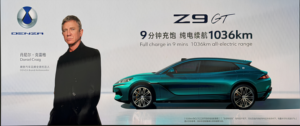
As I touched on in my article I penned for my 25-year history of EV driving on Smerconish.com in January 2024, in the early 90s it was General Motors that developed the first modern EV, the GM EV1, but not only GM but Ford, Chrysler, Toyota, Nissan and Honda squandered the opportunity back then. It looks like we are missing the opportunity again, and we may never recover if we don’t get serious and invest more into development and deployment of the future of transportation & battery technology.
The timing for the U.S. government and U.S. market pulling back on electrified transportation, our attacking Venezuela and the war in Iran this year has enabled China to position themselves to be able to capitalize on these events with great speed. I am not in any way suggesting that the current administration has been coordinating these events with China’s, but our actions could not have come at a better time and/or be a better gift to China than if we had been working with their interests in mind and not those of the American people.
To paraphrase Professor Ray Wills whom I heard speak on Robert Llewellyn’s “Everything Electric” podcast recently: China is clearly leading the future as the electro state, U.S. is the petro state firmly stuck in the past. I am also confident that future generations will eventually think that using explosive liquids for transportation was a crazy and bad idea.
My recent trip to China has made it clear to me just how far ahead of the rest of the world China is regarding transportation and battery development and that the U.S. has again missed a major opportunity, in areas that we were once the pioneer and leader. As a country, we need to wake up and understand where the rest of the world is heading AND that we are being left behind as our shining city on the hill just gets dimmer with another missed opportunity.

Larry Paul has more than 28 years of professional experience in high-frame rate 2D and 3D as well as domes and curve screen systems that are used in high-end specialty display systems for theme park, giant screen, planetarium, visualization, and simulation applications. He has passion for and expertise in solving specific customer challenges and improving the user experience with design. He has been named as co-inventor on six patents. He worked with acclaimed film director Ang Lee on Gemini Man and Billy Lynn’s Long Halftime Walk, his two high-frame-rate film projects that were created and projected in limited release at 4K, 120Hz per eye in 3D. He also worked closely with special effects wizard Doug Trumbull on his Magi format.
Larry and his wife have been enthusiasts of mid-century modern design and architecture for over 30 years. They thoughtfully restored their Herb G. Reisenberg custom ranch home and are now doing a sensitive restoration and enhancement of a mid-century modern home designed by Paul R. Williams.
A life-long transportation enthusiast, Larry was part of a crew that restored a WWII flying wing. He has rebuilt and shown numerous classic and muscle cars. He is an advocate for the future of transportation with electric and autonomous vehicles, and he and his wife have now driven over 400,000+ miles in electric vehicles over the course of almost 28 years.