


David Boies is one of the most prominent trial lawyers in the United States. His client list crosses the political divide. In 2000, he represented Vice President Al Gore before SCOTUS in Bush v. Gore. Later he teamed up with conservative attorney Ted Olson, a former solicitor general under President George W. Bush, to challenge California’s same-sex marriage ban. But he’s also represented major blue chip corporations like IBM and Oracle in high-stakes commercial litigation. Today’s must-read in my newsletter is Boies’ essay in the Wall Street Journal under the headline: “Partisanship on Iran is Dangerous for America”.
In case the paywall prevents your access, here are the key graphs:
Those of us who generally oppose Mr. Trump but who recognize the threat Iran poses need to support the military action not because we owe anything to Mr. Trump, but because we owe it to ourselves, our country, and our children.
If we opposed the war and succeeded in pressuring Mr. Trump to curtail it before the mission is accomplished, we would have the satisfaction of defeating someone we generally oppose, which might help ourselves politically. But America would be worse for it.
Even before that was published, the subject of “rallying around the flag” was already on my mind. Two reasons: First, the New York Times published an analysis of how Americans are reacting to the war in Iran. Bottom line – we’re less supportive today than other American military involvement. Check this out:
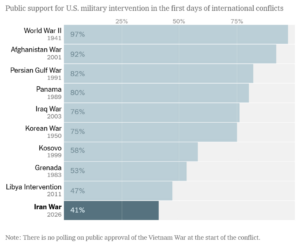
Second, when I saw that analysis, I immediately thought of multi-Emmy-award-winning political journalist Jeff Greenfield. Four years ago, when President Biden was weighing the extent to which the U.S. would support Ukraine against the Russian invasion, Greenfield wrote a memorable piece for Politico in which he explored whether we really, reliably rally around the flag? His conclusion? Only when we are attacked.
Greenfield wrote this:
In the absence of a direct attack, the patience of Americans fades. The shocks at the gas pumps in 1973 and 1979 were inflicted by OPEC, but Richard Nixon and later Jimmy Carter bore the political cost. Today, Republicans may stand and cheer during the State of the Union address when Biden assails Russia, but they are already blaming the president’s environmental and energy policies as the cost of gasoline rises, and that blame is likely to have political resonance.
Well, we haven’t been attacked by Iran. Which may explain the polling data which reveals that Republicans support President Trump’s actions, Democrats do not, and Independents side more with Democrats than Republicans. Maybe that would be different if – God forbid – we’d been struck? I thought Major Garrett framed a great question for Secretary Pete Hegseth on CBS’ 60 Minutes last Sunday when he said this:
Major Garrett: Some might look at that sequence of events and say, well, that it was an opportunity more than an imminent threat.
The Administration has not made a convincing case that we faced imminent threat. Secretary Rubio conceded as much. And I interpret the polling on support for the Iran action to the way Americans answer the Mayor Garrett question to Pete Hegseth. We haven’t been attacked. So, our reaction is mixed. But that takes me back to David Boies, who argues that however we got here in the short term, we need to put aside our partisan differences and support the President.
Wrote Boies:
If we believe that Iran presents a serious threat, we need to support the president on this issue. There’s plenty to disagree with him about, and we don’t need to like or admire him. But on Iran we should be on common ground. Not primarily because we want to reduce partisanship in foreign affairs—although that is conceivable. Not because the voters will reward us for a more measured response—although I hope they will. But because it is the right thing to do for our country, our children and the Democrat who will succeed Mr. Trump as president.
Easier said than done.
##